Traditional Games of India other than Chess – Blog 1 of 14
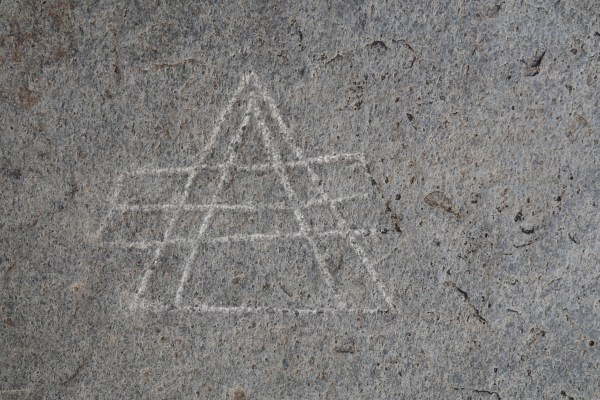
Aadu Puli Aatam etching found near the Butterball in Mahabalipuram
Robert Kanigel in his book – The Man Who Knew Infinity – A Life of the Genius Ramanujan – writes “(Ramanujam) and his mother understood each other. They talked the same language, enjoyed one another’s intelligent company, shared the same intensity of feeling. When he was young, the two of them duelled at Goats and Tigers, played with pebbles, on a grid resembling a perspective view of railroads tracks receding to the horizon, crossed by other tracks perpendicular to them. Three “tigers” sought to kill fifteen “goats” by jumping them, as in checkers, while the goats tried to encircle the tigers, immobilizing them. The game demanded logic, strategy, and fierce, chess like concentration. The two of them revelled in it.”
This exciting game of Aadu Puli Aatam or Bagh Aur Bakri or Puli Meka as it is known in different parts of the country is played with varying numbers of goats and tigers. Variations exist that go from one tiger and three goats to five tigers and 25 goats. The boards too come in all shapes and sizes, but perhaps the board which is most popular of all is the one described by Robert Kanigel.
This curious triangular shape can be found etched on the floor of numerous temple and monuments and in the light of the Chess Olympiad it is interesting to note that many boards are found in the monuments around Mahabalipuram including six boards within a radius of ten feet around the famous Butterball – a gigantic granite boulder resting on a short incline and a major tourist attraction.
Although Aadu Puli Aatam is a game of strategy it is a complete contrast to the game of chess. Originating in peasant homes, this is a hunt game where one player tries to hunt the other. The asymmetry of the game where one player has three game pieces as against 15 of the other; where one player’s role is to hunt and be the aggressor or the tiger against the role of the goat which is to protect each other and immobilise the tiger; results in what looks like a seemingly unequal game. While the goats on the surface look weaker, the game when played effectively is an equal battle between both sides.
What one must remember though is this. The game of chess originated in the homes of kings and zamindars as is attested to by the number of beautiful chess pieces in marble and jade and silver. As such sacrificing a piece to win a game was acceptable as the good of all was greater than the good of the individual.
However, Aadu Puli Aatam is a game of the peasant – the community. Games were played marked on a sandy floor with a stick, or drawn with chalk on f;loors of peasant homes or sometimes etched wth tools on the stone floors of monuments and temples. Every goat sacrificed weakens the community. This reflects a community model where every member of the community must be protected, and they must work together to overcome and neutralise the threats represented by the tiger.
Both models are critical to life today and have important lessons for us. But perhaps the greatest learning of all is the wealth of traditional games representing a wide range of thinking and philosophies. As players battle it out on the black and white chess board, and we watch with bated breath, let us remember these other wonderful games that have been created from the philosophical and cultural underpinnings of our wonderful country.

 Ripples Of Life and Time