Blog 2 of 14 – Two versions of the game board, Butterball, Mahabalipuram
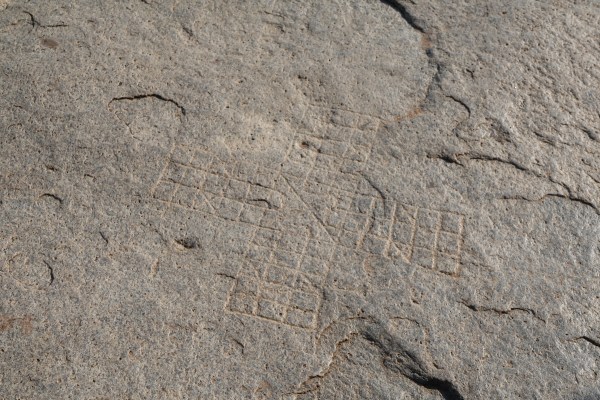

Played on a board shaped like a symmetrical cross, our mythology and even our history is replete with stories about dice games. On the one hand, they have been maligned for leading to gambling and destroying the family fortunes while on the other, stories are told of royal games played on courts of marble.
Over the years the game has been changed and modified and most children have grown up playing its more modern avatar – Ludo. But in its traditional form with its innumerable complex rules the game has provided exciting and fun times to generations of children.
In Mahabalipuram, the location of the 44th Chess Olympiad, numerous boards are found. In fact, four distinct and clear boards are found around the Butterball – a huge granite boulder perched on an incline. The presence of so many boards there makes me wonder if it was a social space – a place where people spent their evenings over a game enjoying the cool sea breeze as it wafted over them.
Another fact I find interesting is that within two feet of each other, there are two versions of the board. One the more popular South Indian version with arms five squares long and the other resembling the north Indian cousin Chaupad, with arms eight squares long. Variations do exist and so too does the popularity of this game.
There is actually no real evidence that the game played in the Mahabharata was in fact this game, but artistic representations of the events have led many of us to believe that this was the game played between the cousins.
But does it really matter whether this was the game played on that fateful day? Does not the fact that it is deeply interwoven with our stories and traditions make it important? I think it does and I also think that this is perhaps one of the most important of traditional games from India.
There are many who would disagree and wonder why this even figures among the important games of India other than Chess. Bear with me and I will explain. The game of chess is an incredible one – complex and exciting matching the wits of two players pitted against each other. But there is no element of chance. In this game however, the role played by the dice is incredibly important for it plays the role of chance. On the other hand, there are numerous decisions a player has to make during the game giving him control and giving him a number of choices. Thus, this game perhaps more closely mirrors life than any other traditional game and that makes it one of the most important games of India. Perhaps that’s why this game has been a favourite of kings and peasants.

 Ripples Of Life and Time