Blog 4 of 14
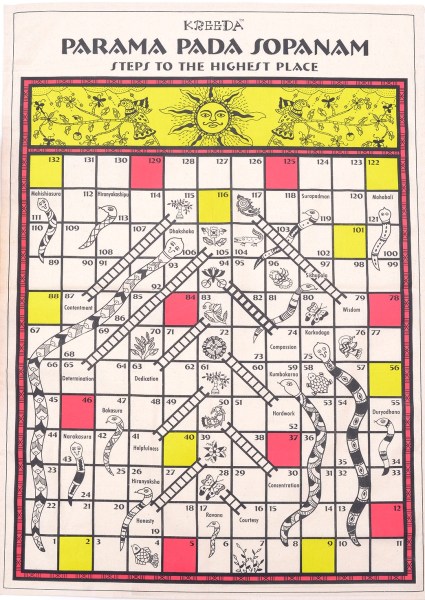
Perhaps the most popular of all games in the world is Snakes ad Ladders. In some form or the other, the game is played by children in numerous countries around the world. In its simplest form as we know it today, the game is merely a dice game with the throw of the dice taking you along the board and determining whether you go up a ladder or down a snake.
However, in its original form the game was so much more. Known by names such as Moksha Pattam, Vaikunta Pali and Parama Padam, the game essentially was meant to provide a road map for personal development leading an individual upwards towards Moksha or the Highest Place. The ladders were meant to represent virtues and the snakes were named by characters from mythology who represented vices.
The origin of the game is unknown and unclear. However, some ascribe it to a 13th century saint, while others ascribe it to the Jains with that version of the boards being used to teach Jain philosophy. But it is not the origin that matters but the essence of the game. In a blog meant to talk about games from India other than Chess, many may find the choice of this game frivolous. And it is true that the game has no strategic elements.
To dismiss the game as a child’s pastime is do ignore its very essence. While there is no strategy in playing the game, the road map it provides is a strategy for personal development. In the world of the 21st century where training and development plays a key role n all aspects of life, it is now common to have a life coach or mentor to guide one along. This game in many ways provides the same role.
The Arishadvargas or the enemies of the mind which are kama (desire), krodha (anger), lobha (greed), Mada (arrogance), moha (delusion), and matsarya (jealousy) not only prevent us from attaining Moksha or Nirvana but also prevent our growth in the material world. Be it in the workplace or at home, some of these vices only pull us down or destroy all that we have tried to build up.
Thus simple games and simple pleasures gave us opportunities to learn and grow as individuals. By removing the virtues and vices, the game has lost its very essence. In the modern form it is only a child’s pastime. But in its traditional form that originated in India, it provides one with much food for thought and a wonderful roadmap for personal development.
So during the 44th Chess Olympiad, while we look at games from India other than Chess, it is impossible to ignore this greatest strategy game of all – a strategy for life.


 Ripples Of Life and Time