Blog 6 of 14
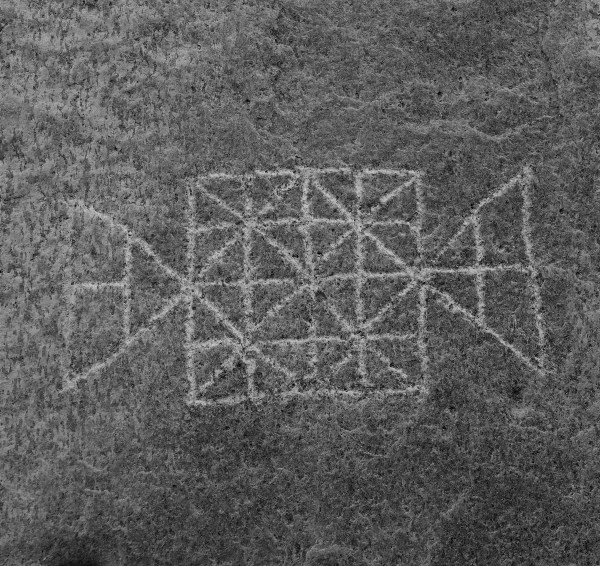
The game of Solah Seedi or Vettai is perhaps the Indian traditional game that is closest to chess, in its philosophy and thinking. Essentially, the game consists of a square with two triangular extensions. There are 37 points on the board, created by the intersection of lines. 16 of these points, on each side are occupied by game pieces at the start of play. The center line is empty. The purpose of the game is for each player to occupy the farthest point of the triangle of his opponent. The game can be won by cutting the opponent’s pieces by jumping over them to an empty point behind or by slipping through gaps on the board.
In essence, it’s a battlefield game at its simplest. But there the resemblance ends to chess. Where chess, in some ways is a far more complex game with different game pieces having different moves, the game of Solah sSedi in its essence much simpler. All game pieces have the same move. They can move one place along the line or jump over another game piece, along the same line.
But to dismiss Solah Seedi as a simpler and poor cousin of chess, would be a mistake. The essence of the game lies in the fact that no matter how many game pieces you have, it merely takes one game piece to occupy the farthest point in order to win the game. So, the player who most effectively deploys his resources and achieves this end is the winner. This ability to deploy game pieces and to play either an offensive or defensive game, makes it a very very exciting game to play.
Additionally, the game can be played with only one point left empty in the middle, and 18 game pieces on each side. Whether 16 or 18 pieces, the game is a battle from the word go because from almost the first movement the opponent is primed to attack. There is no time for you to get the lay of the land or understand the other player’s tactics because there is no space. It’s a pitched battle on a tightly controlled board right from the start.
There are numerous variations to the game indicating that the creativity of the traditional Indian game designer. Boards have been seen with four or more triangular extensions, thus allowing 4 or more players to play the game.
A beautiful engraving of Solah Seedi can be found near the Butterball in Mahabalipuram near the location of the Chess Olympiad currently in progress. The Butterball is a large granite boulder resting on an inclined plane and believed to be there for hundreds of years.
This the presence of this version in Mahabalipuram is interesting because most other engravings of this game seen in Tamil Nadu seemed to have four triangular extensions. The version with two triangles is more popularly seen in the north. Considering Mahaballipuram was an active port during the time of the Pallavas, one wonders whether it is indicative of travelers from elsewhere.
But no matter what the origin of the game, it is a an exciting one requiring strategic thinking under high pressure.

 Ripples Of Life and Time