Blog 7 of 14
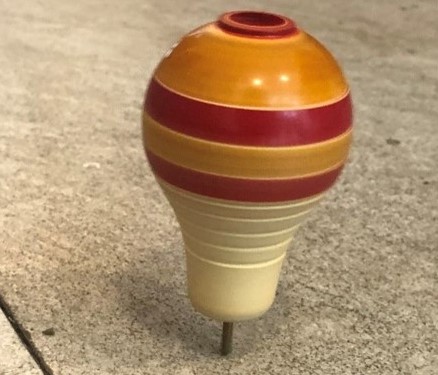
It appears that man has always been fascinated with the top. He has the power to spin it and somehow defy gravity by its ability to stand upright on its point, as if magically. It was discovered, or invented, almost simultaneously and independently in many parts of the world.
There are numerous varieties of tops all over the world and many classifications. The bambaram or lattu as it is called is a throwing top. It is in general, pear shaped, usually with some sort of point at the narrow end. A cord is wound around it and when thrown the cord unwinds causing the top to spin.
These throwing tops are believed to have originated in Asia and are a skill building top, as a player’s skill can be measured and even used in competition. Indian literature also refers to putting a top to “sleep”. This means making a it spin so finely it appears to not move at all!!!
In the 19th century scientists and sailors began attempting to use tops as a scientific tool. The spinning top remains upright, even when the surface on which it stands is tilting. This is what makes the top so fascinating and gives it the importance as one of the traditional games from India other than Chess.
The ability of the top to spin unaffected by the tilt of the surface is a lesson in handling our environment. It reflects the challenges we face each day, the distractions in our life and the need to focus at the task on hand. Even in the game of chess, every player knows the value of concentration – of the ability to tune out the environment, the spectators and even one’s own nervousness or fears and simply perform to the best of one’s ability.
It is this staying power against external challenges that gives one the strength to survive the environment and like the top spin straight on a point almost motionless!
The little Bambaram can teach us some of life’s valuable lessons!


 Ripples Of Life and Time