Blog 8 of 14
The 44th Chess Olympiad has brought the game of chess to the forefront of our thinking in India. A board, specialised game pieces, complex moves and nail-biting matches with strategic thinking have become an aspect to cherish in all games. But it is important to remember that when it comes to Indian traditional games, there is something for every mood, every taste and every capacity and skill. Games of deep concentration are perfect in certain moods but not all of them.
And so, we have a wide variety of games from which we can choose. Not all are board games. Some are played with everyday material. A popular element in traditional play in India is the tamarind seed. The name tamarind is believed to be derived from Persian tamar -i- hind or Indian date. It is a leguminous tree that produces a pod-like fruit that when ripe contains a brown, edible pulp used in cuisines around the world. The pulp is also used in traditional medicine and as a metal polish. The tree’s wood can be used for woodworking and tamarind seed oil can be extracted from the seeds. Tamarind’s tender young leaves are used in cooking. Because tamarind has multiple uses, it is cultivated around the world in tropical and subtropical zones.
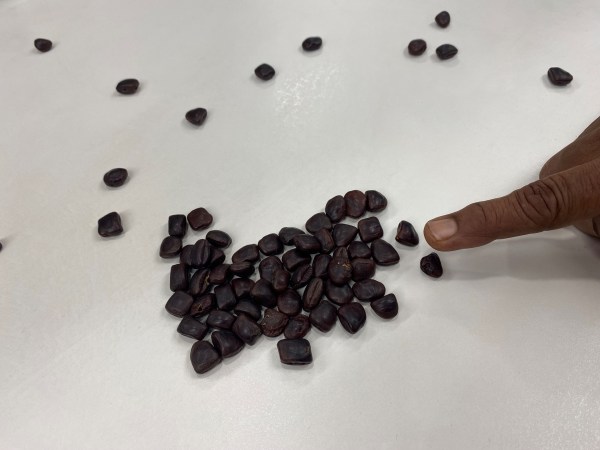
Particularly in the south of India, where tamarind pulp is used in everyday cooking, almost every home would have a tree. When the pulp was used, the seeds were tossed aside and made wonderful play material. The semi rectangular smooth seeds were used as game pieces or counters in many games. Seeds cut in half were often used as throw pieces in place of cowrie shells.
But the seeds really come into their own in a number of games played with seeds of increasing levels of complexity. What these games do have in common is the need to have excellent fine motor skills, nimble fingers and a sense of fun. Perhaps the simplest of all the games is one where you put a heap of seeds in a pile and then blow hard on them. Next you pick the scattered seeds one by one without disturbing the others. This seemingly simple game tests not just the lung capacity of the player but fine motor skills and concentration. After all there is more to life than strategic thinking.
Sadly, with space constraints and the slow but sure transition to apartments, the backyard tree is becoming a thing of the past. Packaged and cleaned tamarind sold in the shops is now the norm, so much so most children don’t even know that tamarind comes from trees. But if one has a collection of these seeds – well aired and stored, they can provide hours of fun.
It is believed that all trees are created from the hair of Brahma – the Lord of creation. The presence of the tamarind tree that is so interwoven with our lives and our culture make it truly a divine creation.



 Ripples Of Life and Time