Lord Balaji of Thirupathi is considered a very powerful deity and thousands of people visit every day to seek his blessings and pray. Their faith is evident in the great hardship they endure and the hours they spend waiting to catch just a momentary glimpse of the deity.
My Golu doll – Lord Balaji – is made of clay and is part of a set with his consort Padmavathi. Although almost 30 years old, the colours are rich and glowing even today. Linking this deity to a traditional game was easy and is based on a delightful story I heard a few years ago.
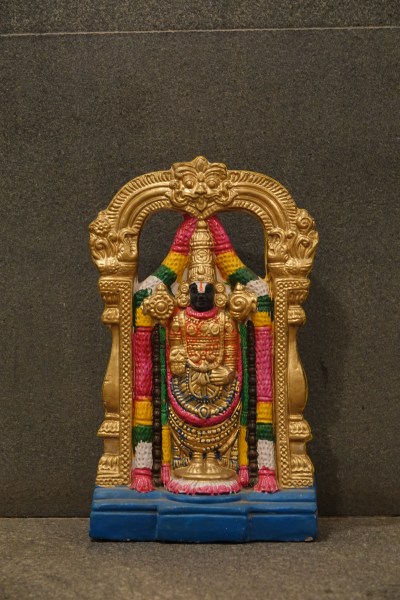
Once upon a time, an ardent Hindu devotee called Bhavaji travelled to Tirumala in Tirupathi on a pilgrimage. He was so fascinated by the deity of Lord Balaji in the temple, he decided to stay there forever. In spite of repeated visits to the temple, he could never get enough of the Lord. In fact, his visits aroused the suspicion of the priests, who then prevented him from entering the temple.
Unable to exist without seeing Lord Balaji, he began to pretend that he was spending time with the Lord by playing a game of dice. He would throw the dice and move his pieces and then throw them again imagining that the Lord was playing with him. One day, the Lord, in the form of a man, actually did visit him and they played together. This went on for many days until something happened. While leaving Bhavaji’s room after a night of playing, the Lord left his diamond necklace behind.
Bhavaji picked up the necklace and kept it safe, planning to return it the next night. When the priests opened the temple the next morning, they found the deity missing a diamond necklace. Immediately, an alert was sounded and the hunt for the necklace began. Some of them remembered Bhavaji’s frequent visits to the temple and wondered if he had been checking out the place prior to the theft.
Sure enough, when they reached his room, they found the necklace. Bhavaji pleaded innocent but they would not listen to a single word. When he told them that he realized it was Lord Balaji who had been visiting him every night to play a game of dice, they mocked him. Finally, he was thrown into a room filled with sugarcane under the condition that he had to consume all the sugarcane by the next day to prove his innocence. ‘Ask Lord Balaji to help you!’ they said mockingly and went away.
Sure enough, as an answer to his prayers, an elephant appeared in the locked room and ate up all the sugarcane. As Bhavaji fell on his knees thanking the Lord, the elephant trumpeted loudly. Hearing the sound, the priests came to investigate and were amazed to see an elephant inside the room. Meanwhile, the elephant broke free and ran away. When questioned, Bhavaji had only one word to say— ‘Hathiram’. When asked who that was and how the elephant entered the prison cell, Bhavaji told them that Lord Rama (an incarnation of Lord Balaji) had come to his rescue in the form of an elephant.
Everyone was amazed at his devotion. He was appointed as the head priest of the temple and hailed as Hathiram Bhavaji or Hathiramji. This fascinating story led me on a quest to find out more in the temple town of Tirupathi. Once there, I tracked down the Hathiramji Math and was shown a shrine with a stylized rendering of a rather corpulent man playing a game of dice with Lord Balaji. I was amazed.
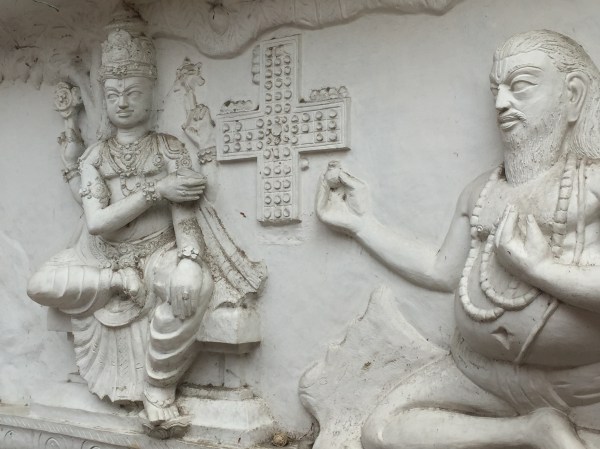
Here was a shrine with an image of a game similar to the ones I had been researching for years. I stood there mesmerized, thinking of all that had happened to lead me there. As my eyes moved towards the lamp, I saw something more—a cloth game board laid out as an offering to the Lord. This cloth game was similar to Chaupad or Dayakattam – a game of played on a board shaped like a symmetrical cross which has long been ascribed as the game of the gods in legends and myths.
Perhaps one of the most popular and well known of games in India it is a fascinating interplay of choice and chance and perhaps the best reflection of life itself.


 Ripples Of Life and Time