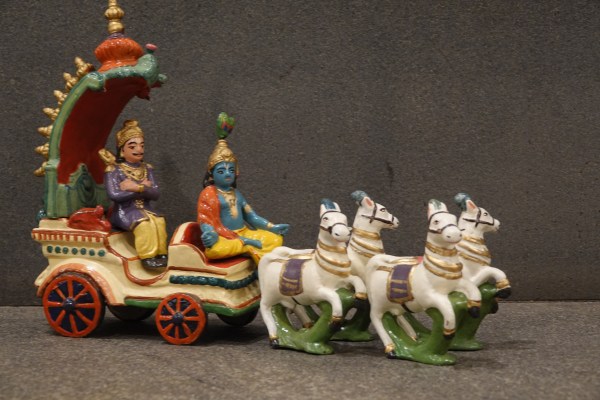
This exquisite and elegantly crafted Gitopadesham made of clay is over 40 years old. The pieces fit together so beautifully from the chariot to the figures of Krishna and Arjuna intricately designed down to the folds of their clothes and the four prancing horses – a wonderful addition to my Golu display.
The Gita is a 700-verse narrative in the form of a dialogue between Arjuna and Krishna and is a part of the Mahabaratha epic. Arjuna is preoccupied before the start of the Kurukshetra War about the moral and ethical dilemma of going to battle against his kin. In his response, Krishna exhorts Arjuna to do his duty, but the dialogue goes far beyond the purview of the war, to discuss numerous ethical dilemmas and philosophical issues.
Interestingly one of the verses relates to a concept that is perhaps reflected in or was even the inspiration for some of our traditional games.
Many of you would have played noughts and crosses or tic-tac-toe in your schoolbooks. While this game usually ends in a draw when both players are evenly matched, India has a whole range of traditional three-in-a-row games that require you to play to a conclusion. But before we go on to understand these games, or how they are played, perhaps it would be interesting to understand why there are so many three-in-a-row games.
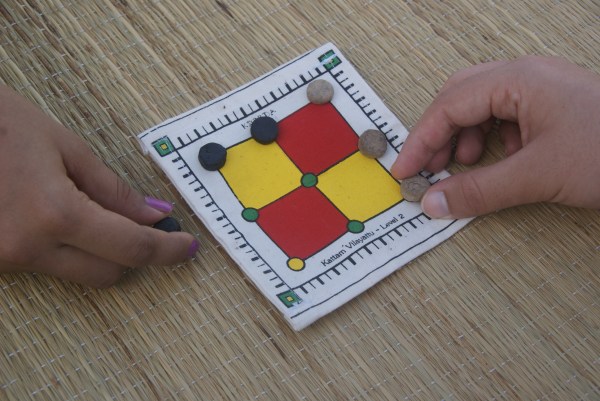
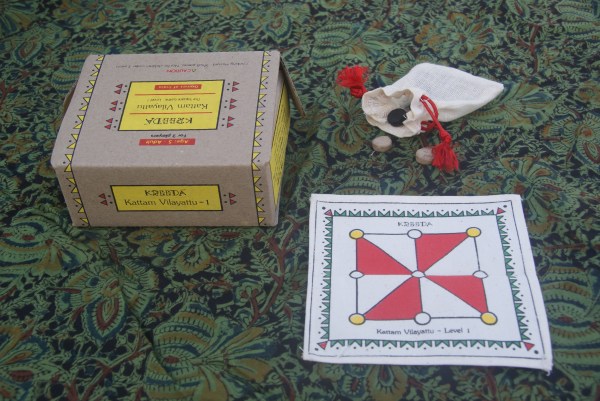
What is the fascination with three-in-a-row? The number three has a long history of mythical associations. The triple deity is commonly known in the world of mythology. From Zeus (Greek king of the gods), Athena (Greek goddess of war and intellect) and Apollo (Greek god of the sun, culture and music) to Osiris (Egyptian god of the underworld), Isis (his wife) and Horus (son), the concept of a triad in mythology across the world is a long one. Closer to home it is echoed in the Hindu trinity of Brah3ma, Vishnu and Shiva.
From a mathematical perspective, is an interesting number. It is the smallest odd prime number and the only prime preceding a square number, 4. The number 2 is the only even prime number and there are only two consecutive natural numbers which are prime—2 and 3. Thus the number 3 has numerous interesting associations and properties.
When we look at it from the point of view of alignment, the penny drops. Two game pieces placed on a board are naturally aligned. When we introduce a third, the alignment is destroyed. Bringing three game pieces into a straight-line balances that alignment.
This is interestingly reflected in the concept of the three gunas—sattva, rajas and tamas [harmony, energy and inertia]. According to an ancient belief, the three gunas are three modes of existence, or the three aspects of nature, and are present in all things in the universe. In order for humans to live a meaningful life, all three gunas are needed. Sattva is required to attain knowledge, happiness and peace of mind. Rajas is required to maintain the body and keep the mind alert. Tamas is needed to rest the body and mind. These three gunas should be in proper proportions, or in other words perfectly aligned for a balanced life. And it is this balance that helps us respond to our environment with equanimity. Thus it is our ability to balance the gunas in perfect alignment that gives us the strength to rise above and not be controlled by them.
In the Gita, Krishna tells Arjuna:
sama-duḥkha-sukhaḥ sva-sthaḥ sama-loṣhṭāśhma-kāñchanaḥ
tulya-priyāpriyo dhīras tulya-nindātma-sanstutiḥ
mānāpamānayos tulyas tulyo mitrāri-pakṣhayoḥ
sarvārambha-parityāgī guṇātītaḥ sa uchyate
“Those who are alike in happiness and distress; who are established in the self; who look upon a clod, a stone, and a piece of gold as of equal value; who remain the same amidst pleasant and unpleasant events; who are intelligent; who accept both blame and praise with equanimity; who remain the same in honor and dishonor; who treat both friend and foe alike; and who have abandoned all enterprises – they are said to have risen above the three guṇas.”
While the games of alignment may or may not be based on the concepts of the three gunas, it is fascinating to note the mystical properties of the number three and how it has penetrated the most simplistic of our childhood games.

 Ripples Of Life and Time