
This Saraswati doll is the pair of my Lakshmi from the previous blog. She is a little run down but again has a soft and gentle expression. What I miss though is this beautiful Saraswati from years ago. Keeping Golu has always been, in our home at least a production. We never had premade steps. Side tables, desks, largs steel boxes, encyclopaedias and back in the telephone directories were pressed into service with planks delicately balanced on them and then covered to create the illusion of steps. I remember times when we really needed something only to realise it was under the Golu.
During one such Golu, my mu’s had slipped, the plank tilted, and poor Saraswati went crashing to the ground and broke to pieces. I loved that doll as she sat on a white lotus, and my mother would sing this haunting song – “velai thamarai poovil irrupal…” (she will be on a white lotus). Try as I might I have never managed to find another such doll and now I am even trying to see if I can recreate it.
For now, this Saraswati works well for us. She got me through all my exams in school and college and my sons through their school and college too. Today, she is a symbol of learning beyond education. She is the Goddess of learning and often we assume that learning and education are the same thing, but life teaches you differently!
And what better game to link to learning through life than Parama Padam or Moksha Path or Gyan Path – the path to knowledge – our very own traditional snakes and ladders. This fabulous game in its traditional foerm had snakes named for mythological characters representing vices and ladders representing virtues. As you move through life, acquiring virtues and shedding vices you reach Parama Pada – the Highest Place.
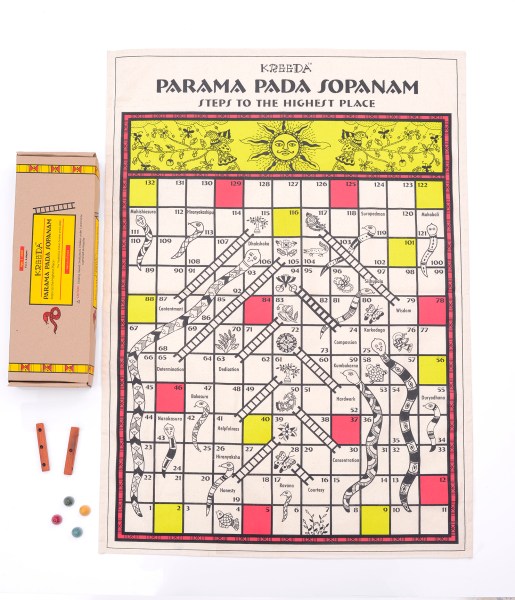
The game appealed to the western world where over a period of time, the virtues and vices and wonderful stories intertwined with the game were lost and the game came back to us as Snakes and Ladders. Sadly, most of us don’t know the essence of the original.
What I find fascinating is that the characters representing vices are not always demons but larger than life people with a fatal flaw that causes their downfall. This concept of a fatal flaw is not unique to this game. Lovers of literature will know that Aristotle described hamartia or the fatal flaw in a character that leads to their downfall. Shakespeare’s celebrated tragedies encapsulate this very aspect. From the jealousy of Othello who murdered his wife based on a rumour, Lady Macbeth whose greed and ambition encouraged her husband to kill the king, to Hamlet’s anger and desire for revenge, the fatal flaw ultimately results in their downfall.
There are numerous similar stories in our mythology – from Mahabali whose pride was his undoing to Ravana who though a devotee of Shiva allowed his lust to overcome him. This game brings us face to face with these characters and more and in the journey to becoming a better person ourselves somewhere we learn to recognise that things are not black and white – that no one is perfect and through this perhaps we become more understanding of people and their failings.
My Saraswati doll got me through school and college but she still has a long way to go for there is a lot I have to learn in my life.
Saraswati Namastubhyam… (Salutations to Saraswati)

 Ripples Of Life and Time