My maternal grandmother used to tell the most incredible stories. She not only had the most fascinating and wonderful stories to tell, but she knew how to add energy to it and how to tell them the exact same way every time, giving us such a sense of comfort. Even today those words echo in my mind.
As a child I enjoyed the stories but as I grew older, I had all the arrogance of a young adult and thought of many of those stories as pointless. Somewhere we have ingrained in our mind the belief that stories have to have a beginning, a middle all leading up to a dramatic or interesting end. Her stories were not necessarily like that. As I grew older however, and life took over, I realized that life is like that. The world is not building up to some perfect finale. The more I thought about her stories, the more I saw lessons in them, or aspects of life itself.
One of her stories was about a little boy who went for a walk, with a very indulgent grandfather. The grandfather loved his grandson and would do anything for him. And as he walked along, the boy pointed out various things he wanted, and the grandfather got everything for him. He wanted a mango, the grandfather got him a mango; he wanted a coconut, the grandfather climbed the tree and got it for him, and so it went on.
After some time, they came across this old lady selling pots. And the little boy cried out to his grandfather, “I want a paanai (pot). I want a paanai. I want a paanai.”
The grandfather shook his head, wondering what on earth the little boy would do with the pot, but he loved his grandson and would not deny him anything. So, the little boy got his pot and clutching it they continued to walk along the village street.
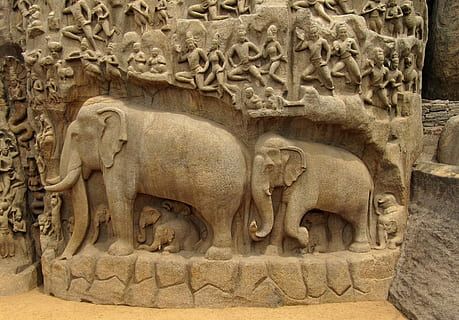
Not long far after this, they came across a man leading an elephant and three little calves. The little calves were waving their trunks playfully at the little boy, and he was thrilled. Now he wanted an elephant.
His grandfather tried to reason with the boy and tell him no. But the boy lay down on the ground and rolled around, throwing a tantrum.
“I want a yaanai (elephant), I want a yaanai,” he cried out.
His grandfather was a wealthy man and if his grandson wanted an elephant, he would have an elephant. So, after much negotiation, he took charge of one of the little elephants and started leading him home. The boy skipped happily, along with his grandfather, now munching his mango and hugging his pot close to his chest, his pocket bulging with all the goodies his grandfather had bought him.
But slowly his steps became slower and slower and slower, until he turned and looked at his grandfather.
“Now, what do you want?” asked the grandfather.
The little boy looked at the grandfather and said, “I want to put the yaanai in the paanai. (I want to put the elephant in the pot).”
The grandfather gave up, “Put the yaanai in the paanai? How can you do that?” he asked. “You can’t do that.”
But the little boy was not satisfied. He rolled on the ground crying. “I want to put the yaanai in the paanai.”
My grandmother’s story just ended there, and I wondered why she told us that story. The meaning of this story actually hit me about this time.
My children were growing up, responsibilities were heavy. I had my regular job, and I had my passion for Kreeda. It was absolutely impossible to balance them all, literally putting the yaanai in the paanai, literally trying to do more in a day than there were hours.
It was time to take stock. One of the biggest challenges I found with Kreeda is that people didn’t just want to turn up and buy the games. They actually wanted you to play with them, to teach them to take them through the rules, to help them figure it out. I have no reason why. I never quite understood it. People would go to a shop and pick up a game of Monopoly, but they wanted the Kreeda team to be there to play, teach and talk about the games.
There was something novel, strange about the games, fascinating even. And in some way it reached into a very elemental part of their lives, and they enjoyed that, and they wanted to share that and wanted us to share that with them. What it meant was numerous programs in the weekends and evening. Time that was taking me away from the family more and more. It was impossible to keep a balance, so I decided to take a small step back, to do things at my own pace.
Not a very common attitude in a startup. Most people who run a startup want it to grow quickly. But I took a decision to let things grow slowly. It wasn’t an easy decision to make. It wasn’t, in many ways, a pleasant decision to make. It was getting me to choose between two warring parts of my life, my family, and my passion. It was hard, but it was a choice that had to be made.
So instead of trying to put the proverbial elephant in the pot, I chose to put the elephant aside for a little while so that I could continue to grow Kreeda at a pace which suited me.


 Ripples Of Life and Time