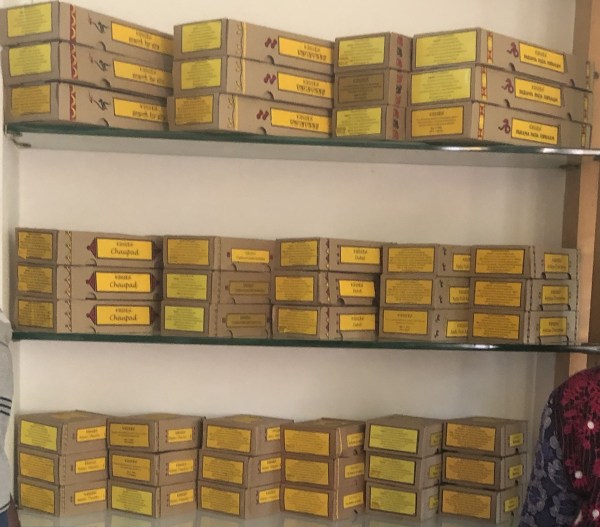
To me, managing Kreeda ought to have been a breeze. I imagined training a couple of people who would flit around the office, reply to orders, collect game pieces, count them out accurately, put them into the boxes and sell the games. Little did I realize; I was living in a fairy tale. If one can think of the 100 things that can go wrong in that scenario like this, I had 200 that went wrong.
It was a time when I realized what we call common sense is not very common after all. Stocktaking, which to me seemed a simple question of counting the number of pieces was invariably a disaster, with the number of pieces on the shelf rarely coinciding with the number of pieces we ought to have. Game pieces went missing, games went missing. And then turned up sometimes later, almost like they had a life of their own.
We had no real systems at the time, merely a simple excel sheet maintaining our stock and human error was all too common. Our games stocked in cartons piled one on top of the other for want of space. This created a whole different set of problems because no one wanted to dig through cartons to do stock, so invariably the stock numbers were wrong.
I had not even reckoned for things like damages. How did one account for that? What did you do if you had a damaged carton? What did you do if you had a damaged canvas? Badly damaged pieces were easy, they were trashed. But the charm and beauty of some of our games is the fact that they are screen printed, and handmade, which means mistakes do occur. Printing never aligns perfectly and each piece was never exactly like the other. But customers would often refuse games with these issues. I had a customer who actually measured the game pieces and complained that they had slightly differing circumferences.
I have had customers return a game because there was a knot in the wood. It is wood, for crying out loud, it’s a natural product, how do you prevent a knot? I’ve had customers complain because the courier was delayed. The courier, of course, considered us a small, insignificant company and would not give us the time of day.
Many suppliers wouldn’t work with us because our numbers were too small, too insignificant. I remember a carton manufacturer talking to us and asking us how many cartons we wanted.
“About 500,” I said hesitatingly because I thought that was a rather large number and that was the highest I could go.
“Sure, 500,000 is not a problem,” was his reply. I
I said, “No, no I meant 500.”
He looked horrified. “Ma’am, we touch nothing under 5000.”
I think this it was at this point my long-suffering husband got involved. He always had the greatest respect for my work, but frankly, I don’t think he ever understood the passion or the excitement that drove it. He was a traditional businessman who was all about profit and loss.
He stepped in to help and told me they made some dire predictions. “If you go on like this,” he said, “People are going to cheat you.”
And so, we moved Kreeda which had earlier been in my home to his office, where we put in systems and procedures, and complex IT solutions for everything. But he was not satisfied.
“You need to have systems in place, or you are going to get cheated,” he said.
But I always believed in the best things in life, was always positive and I was satisfied with what he had done. I truly dreamed there would be a happily ever after.


 Ripples Of Life and Time