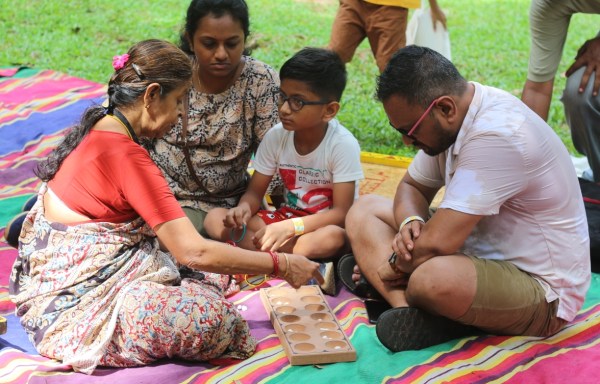
For many years now I have been working to revive traditional games. But to me, it was games, it was fun, some part of our culture that we ought not lose. But that’s where the meaning or the essence, the importance of it ended. However, various things happened that slowly changed my perspective and it started to dawn on me that traditional games are actually very important, and by losing them, we’re not merely losing a sense of our culture, we’re losing much, much more.
Discovering games inscribed on the floors of temples was important to me in a historic cultural sense; in understanding just how old and rooted these games were. But there was another little incident that changed my perspective too.
I am always excited when I see people buy my games or hear from people who have bought my games. To this day, 20 years later, it gives me a high, there’s this sense of pride that something I have created, I have been responsible for is sitting on the shelf in someone’s home. They have bought it, they have played with it, they’ve spent hours enjoying it – it has left some memory in their lives.
The first time this was really brought home to me, was when I received a call from an elderly gentleman. He had dropped by our office a few months earlier to pick up a Pallanguzhi. He was travelling to the US to visit his son. He had lost his wife a few years ago and this had become an annual pilgrimage for him. There was a grandchild there, and the purpose of the visit was supposedly to spend time with the grandchild.
His call was heart-warming. He told us of how he used to visit every year and while he tried to spend time with his grandson, there were very few things they had in common, and it became very difficult to establish a rapport. This year, however, he had taken the Pallanguzhi, and taught his grandson how to play it. The grandfather told us with pride that his grandson would run home every day from school to play Pallanguzhi with him.
“Thank you,” he said, “you have helped me reconnect with my grandson.”
It was a call that touched me deeply and got me thinking. The more I spoke to people, the more I realized that in olden times joint families came together to play. Uncles, aunts, cousins, sometimes even neighbours. When the sun set there was little else to do. There were no TV’s. There were no individual laptops or handheld devices, so the entire family came together over a game.
As one lady told me, “The fights of the day were put aside for the game. The minor irritations were all put away so people could play together. Perhaps the games helped create better relationships or at least help people to develop the ability to tolerate one another.”
The more I looked at the games, the more I realized how elemental they were, how easy it was to pick up the rules. It did not matter whether you were old or young, rich or poor, educated or uneducated. Nothing mattered because you could bond over the game. And to me that was a Eureka moment.
Suddenly it became more and more important for me to revive traditional games. To have people play together, to remember those moments, to cherish those moments, and maybe go back to those moments and think about the relationship.
It was no longer just the fact that the games are rooted in our culture. The games really mattered. And it took that elderly gentleman and his relationship with his grandson to teach me that lesson. I don’t know where they are today. I don’t know where the grandchild is, but somewhere if he has fond memories of his grandfather and him playing a Pallanguzhi created by me, I’m glad to have made a difference, to have done something that matters.
 Ripples Of Life and Time