All the tales I’ve heard about traditional games being played in the olden days, as well as my own faint memories of childhood, have helped me develop an image in my mind ― a large family gathering with bustling aunts and noisy uncles, children running around, grandparents indulgently watching, everyone surrounding a game of Dayakattam (or Chaupad). Laughter, quarrels, dissension, cheering, all part of that same noisy family gathering. Of course, it was probably accompanied by copious amounts of hot coffee with foam on top, served in the traditional Indian-style tumbler and dabara, with steam rising from the surface, and plates and plates of hot golden bajjis, with melting potatoes and translucent onions.
The whole picture sounds wonderful. Sadly, Kreeda can’t recreate everything ―only the games. It is up to you to supply the rest.
But this concept of community, of families coming together, neighbours watching by, participating in the game, which would often happen on the thinnai, or the platform outside the house, is something very appealing to me. So, Kreeda has taken on numerous initiatives to take the game to the community and the people.
One of my favourite memories is from 2018 when we had a car, brightly decorated with all our traditional games, driving around Chennai for a month. It stopped wherever, whenever people wanted to play. Everyone got into the spirit of it ― from the policeman who gave me permission to decorate the car, and told me that I should decorate not only the sides, but the top of the car as well, so it could be seen from buses, to the numerous people who thronged to our events at schools, factories, offices, public spaces, libraries, and much, much more.
The Chennai metro got into the act as well and had us play games in Metro stations. Something I was a bit wary about. Would people play in a metro station? I was shocked and surprised at the response. There were times we had close to 100, 150 people come to play our games. This included one old couple who faithfully visited every single metro station just to play our old games — and they played them all. From the board game set up on tables, to 5 stones and tamarind seeds, comfortably seated on the floor as the ebb and flow of metro life went on.
Families came together to play the game. Communities participated, with strangers battling it out over a game of Aadu Puli Aatam, Dayakattam or Pallanguzhi. Metro staff were fascinated. Organizers everywhere enjoyed it. And the bright, red Chennai car, driving around, responding to calls to come and play games, was truly a wonderful experience.
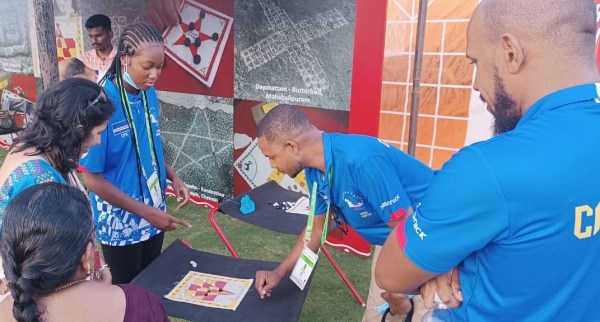
It taught me that all our games are beloved by the community, by the people at large, people who are seeking their traditions, the cultural roots of our own country. But it did not just end there. Last year, during the Chess Olympiad in Chennai, we were fortunate enough to be invited to display our games. The response was staggering. Not just people from India who were visiting the tournament, but players from across the world ― from France to Japan to Bangladesh to Nigeria to Kenya to South America― played our games. And after the battle over the chess board was over, we often had countries competing over a game of Aadu Puli Aatam or Pallanguzhi.
What was even more heartening, was to hear them talk about the games they have played in their own country, the similar games they played, the names they called them, and the rules by which they were played. I was not surprised. For although our games have been played in India traditionally, similar games have been found across the world.
‘How?’, one might ask. ‘Why?’ These games were exchanged along trade routes as people travelled, perhaps. Ideas and games played by communities coming together by people speaking different languages but bonding over a game. And so, the games carried on to different parts of the world.
And today, while our foods may be different, our clothes may be different, very often, when we meet, we find our games are the same. These games are rooted in elemental human values of synergy, of triumph, of winning and losing. And these games can bring people across the world not only because they are easy to pick up, but because many of them share memories of their same games. As one chess player from Africa told me, “I played this game with my grandma”, many of us can relate to the same game he was talking about ― Pallanguzhi.
So, no matter where we are, distances can separate us, languages can separate us, but we are united by our games.
One family, one country, one world, and one game.
 Ripples Of Life and Time