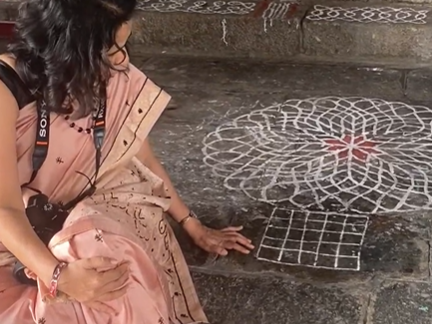
There is an old proverb which says, “May you live in interesting times.” I’m not sure if I have got the wording correct but that’s the essence of it, and Kreeda definitely has given me all the interesting times I need.
There have been highs and lows, the thrill of creation, the pleasure of an event, the adrenaline pumping, excitement of a nail-biting game. All of it is there in Kreeda in a wonderful mix. But Kreeda has given me one more thing – it has given me mystery.
When I started researching games in temples and monuments, I first thought it was just about looking at the games and photographing them and maybe figuring out the rules. I soon realized there was so much more, so many questions that came up, questions to which we will never know answers, questions that allows my imagination free reign to believe whatever I choose to believe.
How did a game that is more popular in northern Karnataka find its way to the Kapaleeshwarar Temple? Was it workmen from there? Did they miss their home and sit down to play with a colleague from their hometown in an effort to capture the feeling of home? Was it the children who accompanied their families who taught the games to each other – ragged children with torn clothes and tangled hair learning to mingle with other local children?
What is the game in the Thiruvanmiyur Temple? It is a strange board not seen in any other temple across Tamil Nadu. Is it a game? Is it not a game?
How did a game come to be carved under the Butterball. (The Butterball is a huge rock on an inclined plane in Mahabalipuram). How many hundreds of years ago was the game inscribed there? When did the butterball move?
What is that unfinished flower that I see in so many temples? Is it a design? Is it likely that the same unfinished design can be found in different temples? Is that a coincidence or is it a game? There is a Maori game that looks similar to this. Could this be a game too? Was there a similarity between games of the Maoris in New Zealand and India? That may seem far-fetched but I have heard of a temple in Tamil Nadu where a boomerang is placed in the sanctum. If a boomerang can find its way to a temple, can a Maori game not find its way to India?
There are similar games across the world. How did they travel? Did people think of them on their own at the same time? Is it possible? Definitely yes, because these games are based on simple patterns and elemental human values.
Take children from five different parts of the world and leave them in a room with black and white checkered floor. In an hour they would all have come up with a game and you will see numerous similarities in these games. If that can happen with the checkered floor, why not with other patterns?
Does the game of Dahdi strangely resemble a temple plan. Was that what it was first? A temple plan etched on the stone and did a game develop from that, or was it the other way round?
It is absolutely fascinating. And today, I look at every pattern on the floor, on the wall, and I see similarities to games. Some of these patterns are so universal.
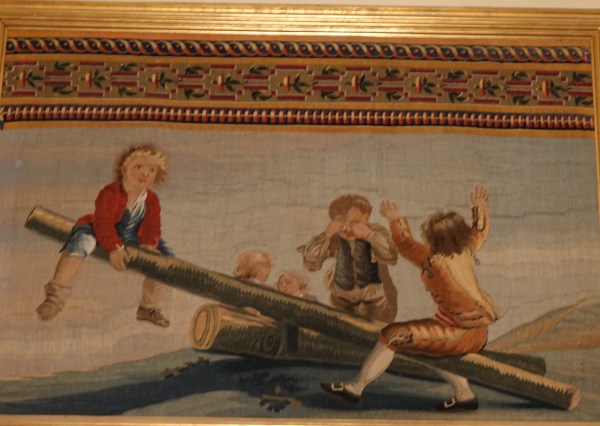
I don’t know the answers to many of these questions, but I do know one thing. Games are not something apart from life. They are a part of life deeply intertwined with culture, design, architecture, human thinking and behavior. And that is a whodunnit for which I definitely have an answer.
Games are a part of life.


 Ripples Of Life and Time