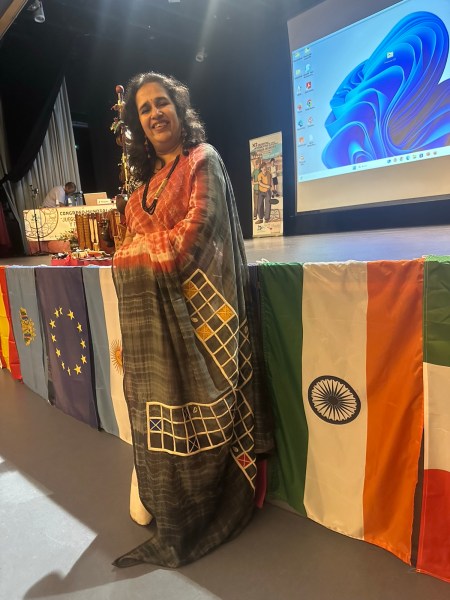
It was the day of the conference. A phone call from Madras woke me up at4:30 in the morning. It was unimportant, but I could not go back to sleep There was a sense of excitement, fear, and anticipation. I pottered around the room. doing nothing. until I finally dressed up to go. I’d initially chosen to wear a sari with a game of Dahdi or Nine Men’s Morris embellished on the pallu. It was the theme of my speech, and I thought the sari would be a wonderful way to emphasize the theme.
Unfortunately, I had a wardrobe malfunction. Luckily, he had brought a second sari with the dice game of Chaupad or Pachis designed by Lakshmi Srinath. I had a set of earrings that represented the gotis or game pieces and a necklace made from a single long dice.
Aranda is a small town and in the old city, everyone knew we’d come for the conference. Everyone stopped to look at the sari, recognized the game as Pachis. and even wanted to take photos. There was a lot of curiosity over the sari and the jewelry, and a lot of appreciation for the way it had been integrated into the theme of the conference.
It may seem frivolous to some to do this, but to me, it has been a clearly thought-out strategy. Games cannot merely be a conversation when we play. They have to permeate our everyday lives. They need to become part of our life again, like they were hundreds of years ago. By wearing clothes and jewelry and accessories with games on it, I help begin conversations, even among those who are not actually playing, are not actually interested perhaps in the game. However, as these conversations begin, I believe that over time, they will lead to greater awareness about the existence of games and slowly the popularity of these old games will rebuild.
I entered the conference hall and quickly ensured that my presentation was uploaded and working since it had been done overnight. My biggest fear, of course, was that my Spanish translation would be a wrong, erroneous, or even offensive in some manner. I solicited the friend to help of a friend to sit at the front row and signal me if there was something seriously wrong with the Spanish.
One of the challenges I faced at the conference was that many who presented detailed papers were in Spanish and translations were not done for them, because the English-speaking delegates were very few. It meant that we were completely reliant on the photographs and visuals to understand what was happening. Thankfully, not all the papers were detailed presentations. Unlike many other conferences I had been to, attire was casual, and some of the presentations were actually demonstrations on stage.
I went up for my presentation with a little frisson of fear. But when Carlos introduced me and even made mention of the sari I had worn for the conference, I twirled around on stage and got a cheer from the audience. As I started speaking and sharing, I was able to see the engagement of the audience and my fears vanished. I was on home ground. I knew how to do this. I was happy, relaxed, and most important, my presentation was received very well. I got a huge cheer after the paper and many people came up to congratulate me. saying “muy bueno” which was very good in Spanish.
Now that the presentation was done, I could relax and enjoy the rest of the trip.

 Ripples Of Life and Time